PUBLISHERS

akadeemia kirjastus
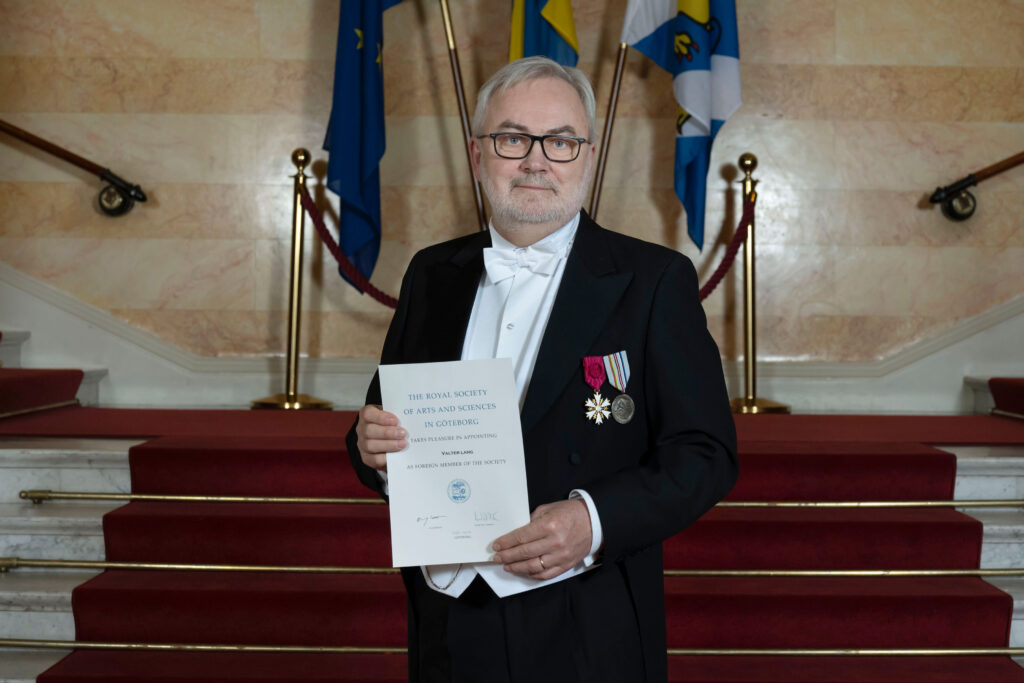
Photo: private collection
‘We have grown from an early-adolescent post-Soviet national discipline into a mature, internationally engaged discipline of national significance,’ says Valter Lang, long-standing Editor-in-Chief of the Estonian Journal of Archaeology (EJA), Member of the Estonian Academy of Sciences, and Professor of Archaeology at the University of Tartu.
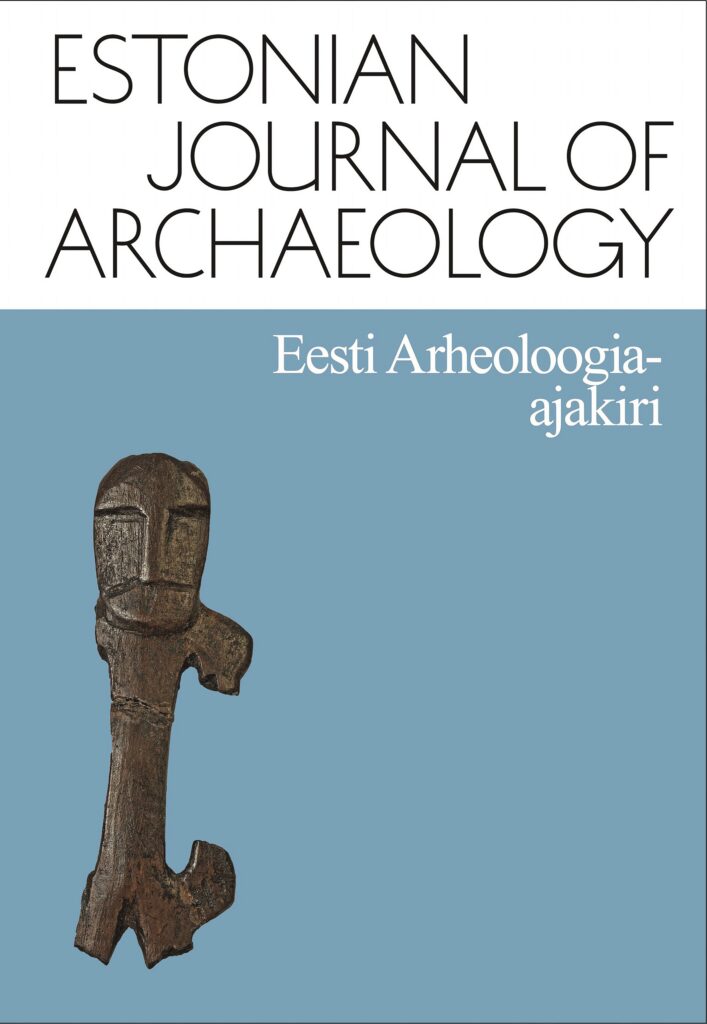
To start with a simple question: who is the little bone man who has graced the cover of the archaeology journal for years now?
Archaeology journals around the world adorn their front covers with an emblem that is theirs alone. The vast majority use an archaeological artefact for this. We, too, were looking for something that, firstly, had not already been used by others and, secondly, had been found in Estonia and was therefore distinctively ours. Thirdly, it had to be sufficiently ‘artistic’ to work as a design element. From among many candidates, we chose a human figurine made of bone, found at the Neolithic settlement site of Tamula. Such small-scale sculpture is known elsewhere in the forest zone of Eastern Europe as well, and its age goes back some five to six thousand years. This ‘Old Man of Tamula’ has no particular name, and at the time we chose him, he was among the oldest known depictions of people who once lived in Estonia. Today, of course, there are also other contenders for that title.
You have been Editor-in-Chief of EJA since its founding in 1997. How did the journal come about?
EJA was founded in 1997 together with the historians’ journal Acta Historica Tallinnensia. This happened after the social sciences series of the Proceedings of the Estonian Academy of Sciences, where our archaeologists and historians had previously published their work, was discontinued. Fortunately, the Academy’s leadership at the time understood our need for such journals.
Then again, we ourselves did not yet know exactly what kind of journal we needed, or what publishing a scholarly journal actually involved. For instance, we argued with Jüri Engelbrecht, then President of the Academy, over whether one issue a year would be enough to make a proper journal or whether there should be at least four. Given our small community of archaeologists, who at the time were not all that keen to publish, four would clearly have been far too many. So I put a briefcase full of archaeology journals from across Europe on the table, all of them published once a year, and that was argument enough. For the first two years we did indeed publish one issue a year; then we moved to two issues, as is still the case today.
When did the journal switch to English?
At first, the journal’s main language was Estonian and its name was Eesti Arheoloogia Ajakiri, in English: Journal of Estonian Archaeology. We soon realised that this would not get us very far. So, we switched to English, while keeping summaries in Estonian. We also changed the name, so that the main title became Estonian Journal of Archaeology and the Estonian title Eesti Arheoloogiaajakiri. Formally, the change was small, but its significance was great. And whereas in the early years, we quite often struggled to fill the journal on time, later on, especially after we were granted regional journal status (category B) in the European Science Foundation’s ERIH index, our pipeline has been more full than empty.
What has changed in 30 years?
I think EJA reflects fairly well the great overall change that Estonian archaeology as a whole has gone through, namely its coming of age. We have grown from an early-adolescent post-Soviet national discipline into a mature, internationally engaged discipline of national significance with extensive collaboration networks across Europe.
Where does Estonian archaeology stand in an international context today?
Estonian archaeology is in a strong position internationally, or at least so it seems to us here. This is shown by the many international projects and research networks our scholars take part in, sometimes as leading partners. Within Estonia, archaeology is now part of a national Centre of Excellence for the second time: first as part of the Centre of Excellence in Cultural Theory from 2008 to 2015, and in the current round within the ‘Estonian Roots’ consortium. That, too, attests to a consistently high standard.
Does archaeology in a small country have any advantages over that of larger ones?
None come to mind straight away, because, unlike our sister discipline of history, for example, archaeology is very expensive and resource-intensive. The larger archaeologies simply have bigger purses and therefore broader opportunities, for example for acquiring equipment, hiring staff, funding projects, and awarding scholarships. That said, compared with the other small countries of Northern Europe, we have nothing to be ashamed of; quite the opposite. And in the context of today’s conversation, let me stress that the same applies to the international comparison of archaeology journals: larger countries can boast more numerous and more substantial journals with a broader base of authors, which, admittedly, are not always better in terms of quality. EJA has no reason whatsoever to feel inferior to its sister publications.
You have long studied settlement and landscape archaeology in Estonia and the Baltic region, as well as the question of where the Estonians came from and when they arrived here. Which discovery or new insight has changed your understanding of Estonia’s past the most?
Archaeology as a discipline in Estonia already has more than a century and a half of development behind it, during which a very solid body of data for the study of prehistory has been gathered. A good deal of research has been carried out and many studies have been published, including general surveys of prehistory. The latest of these appeared as recently as 2020 as the first volume of ‘Eesti ajalugu’ (History of Estonia). As a result, it is practically impossible for any single new find or discovery to substantially change our understanding of the past. Admittedly, one does occasionally come across headlines of that kind in the press, but they are driven more by a hunger for sensation than by any genuine novelty of the find.
The development of science and the emergence of new paradigms (in the sense used by the American philosopher of science Thomas Kuhn) do not work that way. Or at least, in most cases they do not. Rather, new ‘bits of information’ gradually accumulate that do not fit an existing theory or interpretation. At first, they are ignored, as people try to squeeze them into existing frameworks as ‘exceptions’, until at some point they reach critical mass and a new, better-fitting explanation is found for why things are exactly as the new finds show. The public often fails to notice or appreciate this spotting and gathering of ‘negative bits of information’, which usually goes on quietly alongside other work.
So, is everything already fairly clear, with no more major discoveries to come?
We should bear in mind that the role of individual discoveries in the development of scientific thought can by no means be underestimated. But here, too, what matters is that the discovery is born into a context, one that is already loaded with those so-called negative bits of information that call for a new explanation. In other words, the discoverer has to know and understand what they have discovered. Or, to put the same idea a third way: even a blind hen can find a grain, but she has to understand what it is good for.
Could you give an example?
When two-thousand-year-old Celtic fields were discovered at Rebala in the early 1980s, they were indeed hailed as the oldest fields in the forest zone of the Soviet Union, but the interpretation went no further. The discovery did not fit the then prevailing view that plough agriculture and permanent fields had been adopted here only several centuries later. Ten years passed, and new Celtic fields were found at Saha-Loo and Proosa, which turned out to be as much as five hundred to a thousand years older. Only then did the penny drop: something in the existing picture of prehistory was seriously wrong. These discoveries did, however, fit very well with the general development of agriculture further west, that is, in southern Scandinavia and elsewhere in north-western Europe, showing that these developments ran in parallel.
Now, a quarter of a century later, I have begun to understand what may really lie behind these fields. Because some ‘bits of information’ gathered in the meantime give me no peace: why have such early Celtic fields not been found anywhere else on the eastern coast of the Baltic Sea? Why do we not see any morphological development of these fields after the turn of the era (as we do, for instance, in Sweden)? It has begun to seem that the laying out of such fields in the Bronze Age should rather be viewed in the context of early Germanic immigration, which is also attested by stone-cist graves, cup-marked stones, and numerous imported bronze objects. Yet this interpretation only became possible thanks to new discoveries elsewhere, above all in the study of ethnic history.
The moral here is that the interpretation of prehistory is an ongoing process; it can never be completely ‘finished’. Every new discovery becomes a discovery only through context and interpretation.
‘Even a blind hen can find a grain, but she has to understand what it is good for.’
Valter Lang
Do you see new research directions or methods emerging (for example archaeogenetics, new dating methods, digital tools) that will significantly change the field in the near future?
A good few years ago, the phrase was coined that archaeology has entered its third scientific revolution (by Professor Kristian Kristiansen of the University of Gothenburg). Science here means the natural sciences, and the first two revolutions refer to the adoption of the stratigraphic method from geology in the 19th century and the introduction of radiocarbon dating in the 1950s. Both were extremely important for dating archaeological material. The driving force of the third, ongoing scientific revolution is archaeogenetics, above all ancient DNA analysis, but also many other fields of the biosciences. This is no longer about refining dating methods. The focus is instead on ancient people themselves and getting to know them better: for example, how they lived, what they ate, what diseases they suffered from, what they died of, and whether they migrated, and if so, where from and where to. Ancient society is increasingly opening up to us in all its diversity.
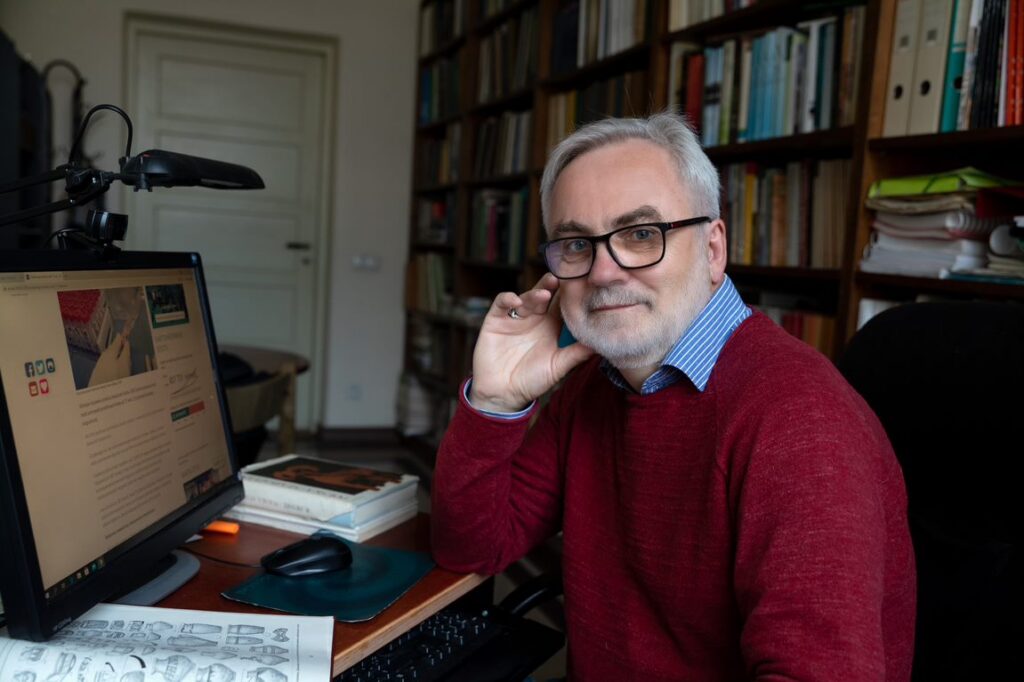
Photo: Andres Tennus
Archaeology is still associated with very physical things: excavations, bones, artefacts, and ancient monuments. At the same time, digital data and artificial intelligence are used more and more. How has new technology changed the way archaeologists study and interpret the past?
The basic tools of excavation, the spade and the shovel, are the same as in the early days of archaeology. Everything else has changed. Here we must not forget that every excavation involves the destruction of an archaeological site. So, if a site is to be destroyed, all possible information must be recovered and documented. Excavation techniques and instruments have changed beyond recognition since my younger days, which has also made excavations, together with the work that goes with them, time-consuming and very expensive. This, in turn, has led to a situation where excavations driven by research needs are carried out rarely and only on a limited scale.
Thanks to new technologies and methods, archaeology can obtain data about the past from areas that until recently seemed like science fiction, such as ancient DNA, diet, pathologies, and so on. All this opens up new possibilities for interpreting the processes of prehistory, although interpretation as such still takes place in the archaeologist’s head, as it always has. Artificial intelligence is not, at least for now, of much help here.
The journal is internationally indexed and recognised, but the wider public may not be very aware of it. Should the results of archaeological research reach Estonians more, and if so, how?
There are other channels of information for the wider public. In archaeology, I have in mind above all the journal Tutulus, which comes out once a year as a substantial, richly illustrated publication and gives an excellent overview of what is happening in Estonian archaeology. EJA is intended for an international audience of archaeologists and specialists, and as such, it has its own clear niche.
How do Estonian universities and the Estonian Academy Publishers cooperate in publishing the journal? What does this cooperation give the journal and Estonian archaeology?
The cooperation between the University of Tartu, Tallinn University, and the Academy’s publishing house in publishing EJA is extremely close; it would be inconceivable otherwise. The journal is made by university researchers, whether from Estonia or from neighbouring countries. The editorial board, too, consists solely of university researchers, and both the University of Tartu and Tallinn University also support the journal financially. The Estonian Academy Publishers provides high-level editing, publishing, and distribution of our research, for which the universities may not have the resources.
What would you advise a researcher who is considering submitting an article to the Estonian Journal of Archaeology? Why this journal in particular?
If your article deals with Estonia or the wider Baltic Sea region, contains new material and interpretation, and is written to the highest international standard, then EJA is the right place for it. The Estonian Academy Publishers ensures high-quality peer review and editing, as well as open access for interested readers around the world. The Academy’s publishing house is also one of the fastest I know when it comes to publishing articles.
What exciting topics await readers in the journal’s anniversary year?
To be honest, I haven’t given it any thought yet. Then again, the ground is full of archaeological surprises. Which of them will make it into print next year? Let that remain a surprise for now.
Looking even further ahead: what might the journal be like in 2052, when a hundred years will have passed since the Academy began continuous publication of scholarly journals?
The Academy’s publishing history actually goes back even further. As early as 1940, the 526-page Yearbook of the Estonian Academy of Sciences, edited by Julius Mark, was published; it was intended to appear regularly, once a year. The war upset those plans, and continuous publication of scholarly journals began only in 1952.
As for the future, the most important thing is that the journal still exists in 2052. Ending the publication of a good journal would be easy enough; a single bureaucratic decision on the grounds that there is no money would suffice. Creating such a journal, however, is immeasurably more complicated and time-consuming. It can be (re)founded by an official decision, but for a scholarly journal to actually work, it must win the trust of the relevant research community and achieve a high enough standard and prestige for anyone to read it and write for it at all. That takes years, even decades. For example, we obtained the ERIH B status (that is, regional journal status) I mentioned earlier only ten years after the journal was founded.
Will the printed journal disappear or survive?
Being an optimist by nature, I don’t believe scholarly journals will disappear. They may well change and take on new forms, but at least for now there is no alternative to them. And if it were up to me, I would certainly not want printed editions of journals to disappear. Our situation is probably different from that of the sciences geared towards rapidly changing information, where only the very latest knowledge counts, because there is not much to be done with the old.
In archaeology, as in the other humanities, old knowledge is just as important as new: old source publications, catalogues, typological studies, excavation reports, and the like may be even more valuable tomorrow than they are today. One may hope that all this will survive in digitised form alone. In my view, however, humanity has not yet reached a level of development at which it could give up a means of preserving culture that has proved itself over centuries: the printed word on paper.
Quick facts: Estonian Journal of Archaeology
- Published since 1997; volume 30 appears this year.
- In English since 2004; formerly titled Eesti Arheoloogia Ajakiri.
- Editor-in-Chief Valter Lang is a two-time winner of the Estonian National Science Prize (1997 and 2011) for research on the prehistory of Estonia and the Baltic region.
- More than 270 articles published in 30 years.
- Articles in English and German, each with a summary in Estonian.
- Indexed in, among others, Web of Science, Scopus, DOAJ, and ERIH PLUS; ranked in the highest category, 1.1, in the Estonian Research Information System (ETIS).
- Open access, free for everyone to read.
- Two issues a year; articles are published online as soon as they are ready.
- Published by the Estonian Academy of Sciences in cooperation with the University of Tartu and Tallinn University.

|
|