PUBLISHERS

akadeemia kirjastus
|
General information to authors
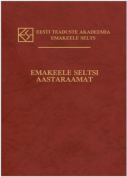
Yearbook of the Mother Tongue Society is a peer reviewed scientific journal published annually by Estonian Academy Publishers in cooperation with the Mother Tongue Society.
Papers dealing with any aspect of Estonian and Finnic linguistics are welcome from researchers worldwide. Manuscripts may be submitted in Estonian or Finnish languages.
It is essential that manuscripts are written in clear and correct language. Authors are encouraged to have their manuscripts linguistically reviewed before submission. The editors reserve the right to adjust style to ensure consistency throughout the journal.
Please also note that the Estonian Academy Publishers’ policy on the use of artificial intelligence (AI) tools by authors and reviewers is available on the journal website under Editorial Policies.
Submission, review, and resubmission
1. The manuscripts must be prepared according to the Instructions to Authors.
2. Each submission undergoes editorial assessment and manuscript is evaluated by at least two anonymous reviewers with expertise in the relevant subject area. The Editorial Board of the Yearbook and the Board of the Estonian Mother Tongue Society assist in the selection and assessment of submissions. Reviewer reports are communicated to authors by the Managing Editor.
3. Suitable manuscripts are sent for peer review.
4. Authors may be asked to revise their manuscript in accordance with reviewers’ comments.
5. Revised manuscripts are evaluated by the editors and, where necessary, returned to reviewers.
6. The final publication decision is made by the Editor-in-chief.
All papers to be published in the journal are double-blind peer reviewed internationally. The duration of the reviewing process is variable, depending on numerous factors. However, typically the entire process from the submission of the first version of the manuscript to publication takes 4 to 6 months.
instructions to authors
publication types
Research articles presenting original scholarly research.
The recommended length of a manuscript is 35,000–50,000 characters including spaces, references, tables, figures, summaries, and appendices.
manuscript elements
Title
The title should be concise and informative.
Abstract
An abstract should be a self-contained summary of the paper, presenting concisely the objectives of the work reported, results, and conclusions. Citations in the Abstract are not allowed. The recommended length of the abstract is 70–150 words (approximately up to 1,000 characters including spaces).
Keywords
Provide 5–8 keywords that do not repeat words already appearing in the title. Keywords should be separated by commas. The list should not end with a full stop.
Headings
Authors are encouraged to structure the article using section headings. First-level headings are generally sufficient. Headings should be numbered consecutively.
In-text Citations
References are cited in the text using the author–date system. Multiple references should be separated by semicolons and arranged chronologically.
References
References should be listed alphabetically by author at the end of the manuscript. Full first names should be provided whenever possible. Digital Object Identifiers (DOIs) should be included where available. Web resources should be included in the reference list. Examples of reference formats should be provided following the ESA style guide.
Abbreviations
Abbreviations other than widely recognised forms should be listed in a separate section before the references.
Examples, Formulae and Linguistic Data
Linguistic examples, formulae and similar material should be presented as separate example blocks and may be numbered consecutively throughout the article.
Tables, figures and illustrations
Small tables and figures may be embedded in the manuscript. Large or complex figures and tables should be submitted as separate files. All tables and figures should be numbered consecutively and referred to in the text. Figure captions should be placed below figures, and table titles above tables.
Summary
The summary is a foreign-language overview of the main arguments and findings presented in the article. For articles written in Estonian, the summary should preferably be provided in English or German.
The recommended length of the summary is 200–300 words (approximately up to 1,600 characters including spaces). The summary should be formatted in the same way as the main text of the article. As in the title of the article, full capitalisation should not be used in the title of the summary.
The summary should be followed by the keywords given at the beginning of the article, translated into the language of the summary.
Author information
The following author information should be provided: first name and surname, institutional affiliation, postal address, and e-mail address, each presented on a separate line.
Detailed manuscript preparation and formatting instructions are available in the full Author Guidelines (PDF, in Estonian).
orchid
The journal recommends that all authors submitting a paper register an account with Open Researcher and Contributor Identifier (ORCID). Registration provides a unique and persistent digital identifier for the account that enables accurate attribution and improves the discoverability of published papers, ensuring that the correct author receives the correct credit for their work. As the ORCID remains the same throughout the lifetime of the account, changes of name, affiliation, or research area do not affect the discoverability of an author’s past work and aid correspondence with colleagues.
The journal recommends that all authors include an ORCID within their submitting author data. ORCID numbers should be added to the author data upon submission and will be published alongside the submitted paper, should it be accepted.
Authors will also need to follow these instructions on the ORCID website: https://support.orcid.org/hc/en-us/articles/360006896394-Auto-updates-time-saving-and-trust-building.
article publication charges
The journal does not charge any submission nor publication fee from the authors. The open access fee is partially covered by the Tallinn University.
Proofs
The author will receive a set of proofs for correcting eventual technical errors. No textual changes may be made and no new material inserted in the text at the time of proofreading.
|
|