PUBLISHERS

akadeemia kirjastus
The Poluverniki, the so-called half-believers who lived in the Iisaku area on the northern shore of Lake Peipus, have long been thought to descend from a Votic population. A study by linguists at the University of Tartu shows, however, that the Poluverniki’s language also had features similar to those of the Northern Finnic languages. One of the most striking was the absence of the vowel õ.
The study’s authors, Petar Kehayov, Professor of Finnic Languages at the University of Tartu, and Karl Pajusalu, Professor of the History and Dialects of the Estonian Language at the University of Tartu and a member of the Estonian Academy of Sciences, published their findings in Linguistica Uralica, a journal of Estonian Academy Publishers.
The missing õ
Kehayov and Pajusalu analysed language material collected by Mari Must and Helle Heiter between 1962 and 1965, as well as word lists of Poluverniki Russian compiled by Jüri Truusmann in 1895.
The vowel õ was entirely missing from the speech of older residents of Vaikla and Liivaküla, even though frequent use of õ is characteristic both of the neighbouring Alutaguse dialect and of Votic. It was replaced by various vowels, as in sona ‘word’ (Estonian sõna) and nuges ‘nettle’ (Estonian nõges). Somewhat as in Finnish, they said menema ‘to go’ (Estonian minema), nena ‘nose’ (Estonian nina), laiv ‘ship’ (Estonian laev) and kaiv ‘well’ (Estonian kaev).
The authors conclude that the ancestors of the Poluverniki spoke a language close to the coastal dialect of northeastern Estonia, particularly the Central Vaivara subdialect. As Vaikla lies 42 kilometres from the coast of the Gulf of Finland, these Northern Finnic features may once have extended further inland than previously thought.
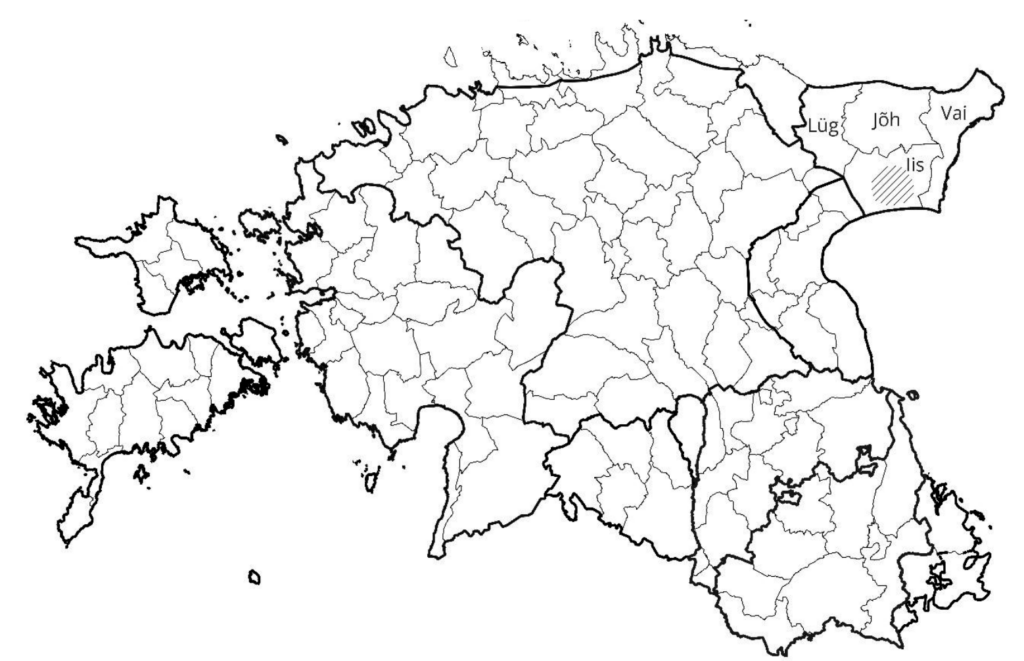
Source: Kehayov and Pajusalu 2026, Linguistica Uralica.
A multilingual community on the northern shore of Lake Peipus
Poluverniki was the name given to Lutherans who lived on and near the northern shore of Lake Peipus in the parish of Iisaku and who, in recent centuries, spoke distinctive Russian and Estonian dialects. The name ‘half-believers’ reflects the fact that the community preserved Orthodox customs after converting to Lutheranism. The villages of Vaikla and Liivaküla, about five kilometres from Iisaku, were regarded as the heart of the community, and Vaikla was even dubbed ‘the capital of the Poluverniki’.
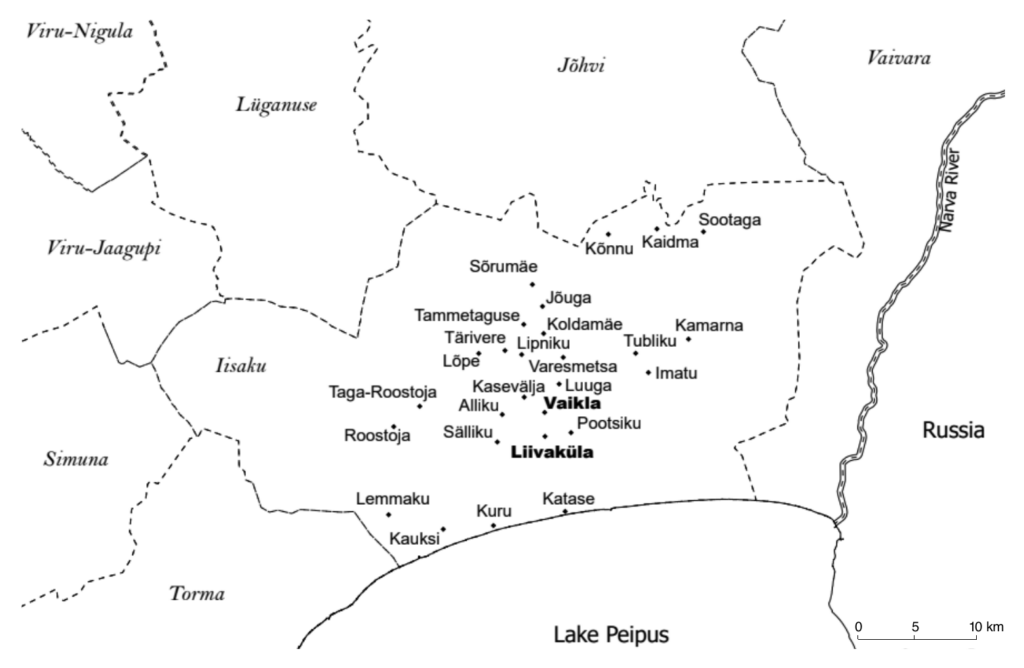
Source: Kehayov and Pajusalu 2026, Linguistica Uralica.
By the 1930s, the area they inhabited had shrunk to a handful of villages, which the Estonian press called the ‘Poluvernik republic’. The community nevertheless remained bilingual until the last decade of the 20th century. Today, the heritage of the Poluverniki is preserved above all by the Iisaku Museum.
Russian points to the northeast
The Russian spoken by the Poluverniki did not fully match that of their closest neighbours either, the Russian dialects of the northern shore of Lake Peipus and the Gdov area. Older speakers often pronounced a clear o in unstressed syllables. At times, l was replaced by a sound like u, as in vouk instead of volk ‘wolf’. The closest parallels to these features are found in the Northern Russian dialects of the Novgorod and Lake Ladoga regions, hundreds of kilometres to the northeast.
The authors offer two possible explanations. Speakers of Northern Russian dialects may have arrived in the area later. It is also possible that Slavic settlers arrived in the early Middle Ages and that their speech preserved old Northern Russian features. According to the researchers, the two explanations are compatible.
In Kehayov and Pajusalu’s view, archaeological investigations of old burial sites around Iisaku, combined with DNA analysis, could shed more light on the ancestry of the Poluverniki.
Science news story by Airi Kaunissaare.
Listen to the Vikerraadio report (in Estonian)
Loe teadusartiklit „Where did the language of the northeastern Estonian Poluverniki come from?“ (Petar Kehayov ja Karl Pajusalu, Linguistica Uralica, 2026, 62(2), 155–179)

|

|