Reili Argus discusses the importance of publishing research in Estonian, children’s language acquisition and the role of the Year Book...
ESTONIAN ACADEMY
PUBLISHERS
PUBLISHERS

eesti teaduste
akadeemia kirjastus
akadeemia kirjastus
Professor Reili Argus: It must be possible to talk about Estonian in Estonian
5 November 2026
Since 2021, the Year Book of the Estonian Mother Tongue Society, affectionately known among linguists as ESA, has been edited by Reili Argus, Professor of Estonian at Tallinn University. In the next interview in Estonian Academy Publishers’ series with editors-in-chief, we talk about what the speech of two-year-olds has taught a linguist, why the Estonian Mother Tongue Society, which is more than a century old, continues to publish its Year Book in Estonian, and how artificial intelligence has begun to influence language.
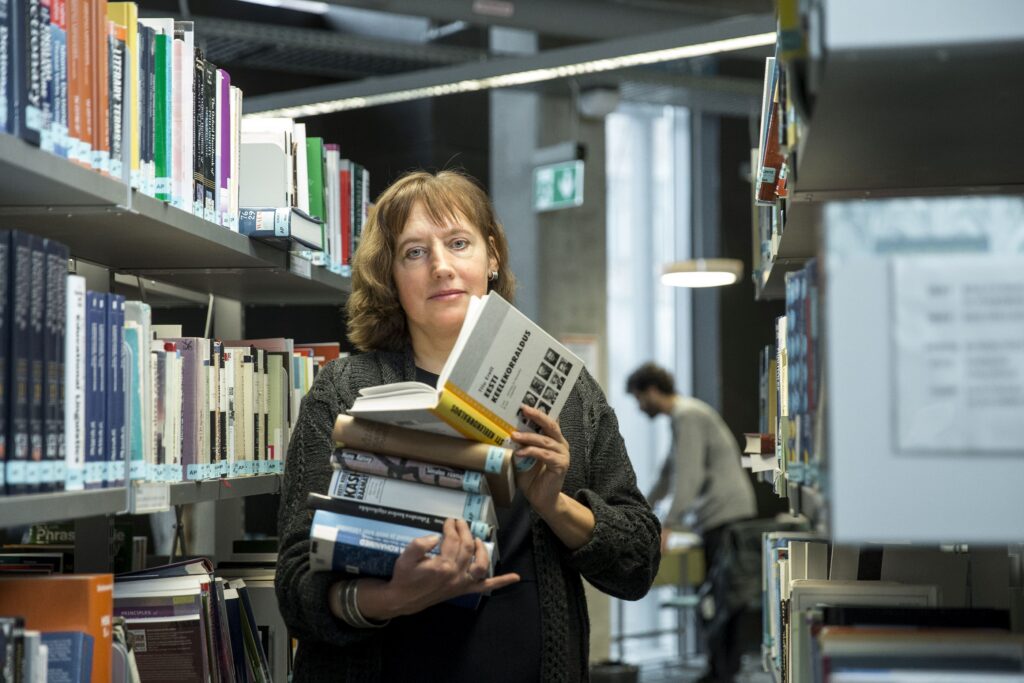
Photo: Tiina Kõrtsini
In 2021, you took over the Year Book from Professor Mati Erelt, who had edited it for more than 20 years. How did that come about?
Mati Erelt decided at some point that it was time for him to retire. When he was looking for a successor, the matter was discussed by the board of the Estonian Mother Tongue Society, and I was offered the role. It was as simple as that. I had not been on the editorial board before, but I was on the society’s board and therefore knew what was going on.
What did you take with you from Mati Erelt?
Certainly the way he encouraged young writers. Even when the reviewers were quite harsh, if he saw that an article had scientific value, something new that was worth working on, he would always encourage the author to keep working, give them a little extra time, support them himself, and tell them what the reviewers perhaps had not been able to put into words. I have tried to continue that kind of personal care and communication.
I have also tried to be reasonable when reviewers are too superficial in style or overly critical without cause. Sometimes two reviews contradict each other quite sharply. If you read the more negative one and realise that it is not neutral but coloured by the reviewer’s personal experience or worldview, something unrelated to the paper itself, you simply ask for a third. So far, my instinct has not let me down: in most cases, the first and third reviews have turned out to be more alike.
As Mati Erelt used to put it so well, you also have to use your own head. An editor can see whether criticism is justified or not. Sometimes there is no need even to send a manuscript out for review if you can see that its quality is such that nothing will come of it. The editor is a kind of filter.
How has the Year Book changed during your time?
I don’t think it has changed very much, and that is exactly what our readers expect. We usually present ESA in Tartu on 27 June, Veski Day, named after the linguist Johannes Voldemar Veski. There is a freshly printed issue on the table, and the editor-in-chief gives a short overview of what can be read this time. At least the first few times, a contented murmur rose from the audience when it was said that ESA was still more or less the same. It was as if people had feared that a new editor-in-chief would come along and change everything, and that is not what readers want.
Some things are different, though. We have regular authors, for example those working on etymology, who write a kind of serial, with the next instalment appearing in every issue. Alongside them, there used to be very little experimental linguistics or other more modern approaches, and very little writing on language teaching.
I have now been trying to make sure that every issue has at least one article related to language teaching. To that end, I go to conferences, and if a talk seems likely to lead to something interesting, I approach the author personally and encourage them to submit an article.
Two thirds of each issue consists of research articles and one third of review articles. Review articles are surprisingly important. As a complete beginner in editing, I regarded them as something of a nuisance: they could not go through the usual review process, their structure was different, and I had the feeling that nobody really read them anyway. It has since turned out that they are widely read. They matter to the Estonian Mother Tongue Society because they document its activities: there is one place where what the society did in the previous year is always on record. Since the last issue, we have also started publishing the decisions of the society’s Language Committee.
Who publishes in the Year Book? Are new young authors coming through?
Roughly a third are more experienced authors who write often. Another third are linguists in the prime of their careers. Their contributions vary, because the Estonian linguistics scene is tiny: the same people write for every publication, and the line-up of a single issue often depends on how deadlines fall and what someone happens to have ready. The final third are young researchers, that is, doctoral students. There are quite a lot of them, and fortunately they keep coming, with exciting topics.
The society has more than a century of history, and the Year Book has been published since 1955. How is the Year Book different today from half a century ago?
Half a century ago the topics were different. There were certainly more topics related to dialect research, and inevitably there are fewer of them now. Today, there are considerably more corpus studies and, to some extent, also experiment-based studies.
So language research has, in a sense, become more practical.
Yes, and in my view that is also something of a concern. Recently, I have seen few papers that are theory-based or closely tied to theory. If I could dream about what the articles in the next issue might be, there would be a couple that deal with genuine linguistic theory: placing their material within models developed by the great theorists, saying whether the model describes that material or not, and proposing models of their own. We now have access to large bodies of text, or corpora, and we can work with them, but we should also say something theoretical about the data we have obtained.
What sets the Year Book of the Estonian Mother Tongue Society apart from other linguistics journals?
If you compare them one by one, Keel ja Kirjandus (Language and Literature) covers both language and literature, and it has developed its own range of topics: little applied research, more historical linguistics, grammar, and semantics. Estonian Papers in Applied Linguistics is devoted purely to applied linguistics, with hardly any more theoretical writing. Language teaching, however, has somehow fallen between the various publications, and we are trying to bring it into the Year Book of the Estonian Mother Tongue Society. Onomastics, too, has traditionally tended to find its home in our Year Book, because the society has generally done a great deal of work in that field. We are perhaps the most central, the most traditional publication of Estonian language research, and I don’t mean that in a bad way. That kind of stability and reliability is a great strength of ESA.
The Year Book is published in Estonian and Finnish. Why not in English?
Because there is already a vast amount of linguistics literature in English. And in my opinion, in the age of artificial intelligence, it is rather pointless to worry that something is in Estonian and an English-speaking reader cannot access it. Out of curiosity, I tried searching for a topic in my own field one morning. There are AI-based platforms where you ask a question and a so-called agent produces a literature review for you. I asked a question (in English) about first and second language acquisition and waited with interest to see what would come up about Estonian. It had used, let’s say, 90 per cent of the relevant Estonian-language articles and summarised them entirely accurately.
But it is important to publish in Estonian, because if we do not work on the terminology ourselves, nobody else will. If we let all of linguistics switch to English, then at some point we will no longer be able to talk about Estonian at all, because we will not have the words. We have tried to keep Finnish because there are still linguists in Finland who learned Estonian at university and could write for and read ESA.
Who reads the Year Book?
Mostly our own linguists, but also language editors and teachers.
In my view, teachers are a community we should reach more strongly. When training teachers at the university, we constantly try to instil in them that studying to become a teacher does not mean you learn it all and are then done. You have to keep learning, and you need certain professional journals that you read throughout your life. This is very difficult, because people’s ability to read academic texts is getting steadily worse. Long texts are feared, academic texts are feared: science seems so frightening that it cannot possibly be understood. Some certainly do read, and there are teachers who have surprised me at in-service training courses by saying that they read it. But certainly not as many as we would like.
Language is closely linked to artificial intelligence. How is AI affecting language?
It is very hard to say, because there is no research on this here yet. If we pose the question at all, we have to think about which language it affects: the language we speak or the language we write. There is certainly some effect, but I doubt whether we are able to recognise it. Spoken language, fortunately, is still spoken language and perhaps more natural. What you do see in AI-generated texts is a great deal of officialese, which AI can neither recognise nor avoid. Our texts probably really are full of officialese, with käesolev (‘the present’), antud (‘the given’), läbiviimine (‘carrying out’), and teostamine (‘implementation’) piled one on top of another. I suppose that is just what our language is like: AI simply has a lot of that kind of text to draw on, and it produces more of it itself.
That is quite an interesting research question.
But terribly difficult to study, because in the end we would be studying what AI itself has produced. At the same time, AI certainly speeds up certain research processes.
AI is also good at things that make an editor’s work easier. Say an abstract is 21 words too long, and you sit in front of the text and cannot think of a single way to make it shorter. AI offers three versions you would not have come up with yourself, and one of the three is usually good enough. So, it sometimes helps you out of a mental block when you have got stuck on your own sentence.
On the other hand, the editor’s responsibility grows. I have wondered whether I can recognise a text produced by AI. In student papers I often can, because when there are made-up sources, which we call ‘hallucinations’, it is immediately clear that the author did not write it themselves. But with a well-made AI text, I am not sure I would recognise it straight away. We need to think about where AI-generated text may appear in research and where it may not. Where there is the researcher’s own analysis, you would want to see text written by a real person.
How did you come to linguistics in the first place?
With many career choices, it is a combination of chance and certain preconditions. One precondition was perhaps that I went to Tartu to study Estonian philology. I had also considered the Faculty of Medicine, but my circumstances at the time meant I could not go there, as it did not offer distance learning. The element of chance was perhaps that in my third year, I ended up in the child language research group led by the Finnish researchers Kirsi and Jorma Toivainen. Of course, that was not entirely a coincidence either, since I had a child at the time, and the research material was, so to speak, available at home.
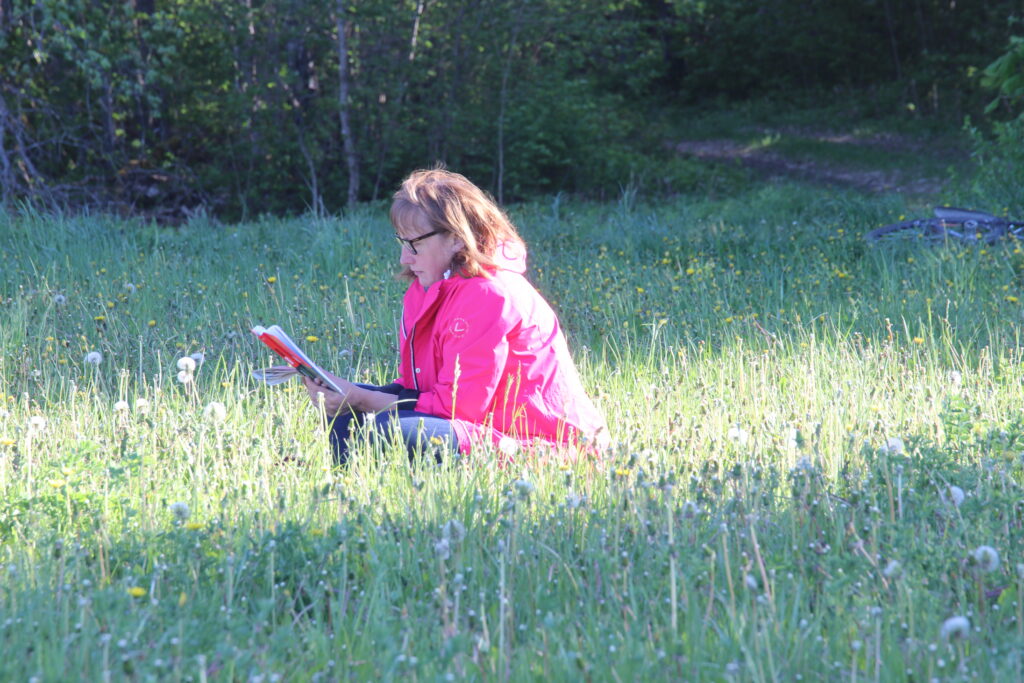
Photo: Tõnis Argus
What have children taught you about Estonian?
I probably would not be in linguistics if it had not been for child language research.
Especially with small children, it is as if at a certain point a window opens and you can see how language works, how language is made. A moment later the window closes, everything is more or less acquired, and the child no longer shows you anything. But it is precisely during the period when mistakes and irregularities start to appear, when a child begins to inflect words such as munat and sabat instead of muna (‘egg’) and saba (‘tail’), or onuseid and tädiseid instead of onusid (‘uncles’) and tädisid (‘aunts’), that you see what lies behind it and how the child is building the language.
At first, a child learns words that have no ending in the partitive case, such as maja (‘house’) and kala (‘fish’). Then, suddenly the first partitive form autot (‘car’) appears, the child realises that the form ends with t, and starts adding that t to the end of every noun: munat, sabat. Or you see how a child performs a kind of back-formation and says see on onu nais (‘this is uncle’s wife’, where the correct form would be naine). You realise that the child has worked out that the genitive usually ends in a vowel and the nominative in a consonant, and so derives the form backwards from the genitive naise: the nominative must therefore be nais. It is such fun to observe things like this in the speech of two-year-olds. But at some point, the system falls into place, the child, so to speak, closes the door, and you can no longer see in.
The Year Book has now been published for 70 years. Where will it be in 50 years’ time?
I think the journal will still exist in 50 years. I hope so with all my heart. Nothing very significant has really happened over the past 50 years: the topics have changed a little and become more contemporary, but the essence is much the same.
I don’t really believe it will still appear in print, though. That is probably a question for the next ten years. At present, we print a small run purely out of nostalgia, and because there are readers who want to have it on their shelves. But the print run keeps getting smaller, we no longer keep copies in stock, and perhaps in ten years those who still want print today will have given it up too. It will probably move entirely online, but we have no idea what form journals will even take in 50 years.
A hundred years ago the focus was on dialect research. What could the topics of the coming decades be?
I think the topics will change, because it is already clear that there are so many datasets obtained with large language models that they will shape the topics too. Topics related to the use of several languages will certainly come more to the fore in linguistics. Unfortunately, we have little research of that kind so far.
There could also be more sociolinguistic topics. If I take just my own field, children in Estonian schools speak more than 150 different languages between them. As far as I know, Estonian linguistics has only studied children whose mother tongue is Russian, and, more recently, Ukrainian children to some extent. In one project, we saw that in a class of 24 children, nine might have a different mother tongue, and those languages included, for example, Yoruba, Bulgarian, and Dutch – very unusual combinations, but they exist. We will probably have to deal with this, but at the moment, it seems that we do not know how, and we would rather turn a blind eye.
So, there is no shortage of research topics. What would you advise those considering writing for the Year Book?
First, ESA is a category 1.1 journal, which cannot be overlooked. Second, it is an old and well-established journal. Third, our editorial process is fairly short. With some international journals, it can take up to two years from submission to publication. With us, it never takes more than six months. The submission deadline is usually around 10 January, and by the end of June, the issue has been published.
The quality of the reviewers may also be important. We no longer use reviewers who simply tick boxes in a table and are too superficial. We have built up a pool of reviewers who do thorough work, and from whom we expect substantive comments in addition to the ticks.
Interview by Airi Kaunissaare
The Year Book of the Estonian Mother Tongue Society
- The Estonian Mother Tongue Society (originally the Academic Mother Tongue Society) was founded in 1920 at the University of Tartu on the initiative of Finnish linguist Professor Lauri Kettunen, modelled on Finland’s Kotikielen Seura, to ‘promote interest in knowing, developing, and researching the Estonian language’. The founding meeting was held in a lecture hall in the university’s main building (now the cloakroom).
- The society’s first yearbooks (1921–1926) were simply annual activity reports. A scholarly year book was discussed in 1946, when the society was placed under the Academy of Sciences, but permission came only in 1954, and the first volume appeared in 1955. Its editorial board was chaired by Academician Paul Ariste until 1990.
- Articles are published in Estonian and Finnish, each with a summary in the other language.
- Every article is assessed by two anonymous reviewers.
- Indexed in the Web of Science Emerging Sources Citation Index, Scopus, ERIH PLUS, and the MLA International Bibliography.
- Open access under a CC BY licence, ETIS category 1.1.
- Published by Estonian Academy Publishers.
- From 1999 to 2021, the Year Book was edited by grammarian Professor Mati Erelt (1941–2024), long-time chair of the Estonian Mother Tongue Society.
Who is Reili Argus?
Reili Argus studied Estonian philology at the University of Tartu and in 2008 defended her doctoral thesis at Tallinn University on the acquisition of Estonian inflectional morphology. She is Professor of Estonian at Tallinn University and researches how children acquire Estonian both as a first and as a second language. She is a member of the board of the Estonian Mother Tongue Society and has been editor-in-chief of the Year Book of the Estonian Mother Tongue Society since 2021.

|

|